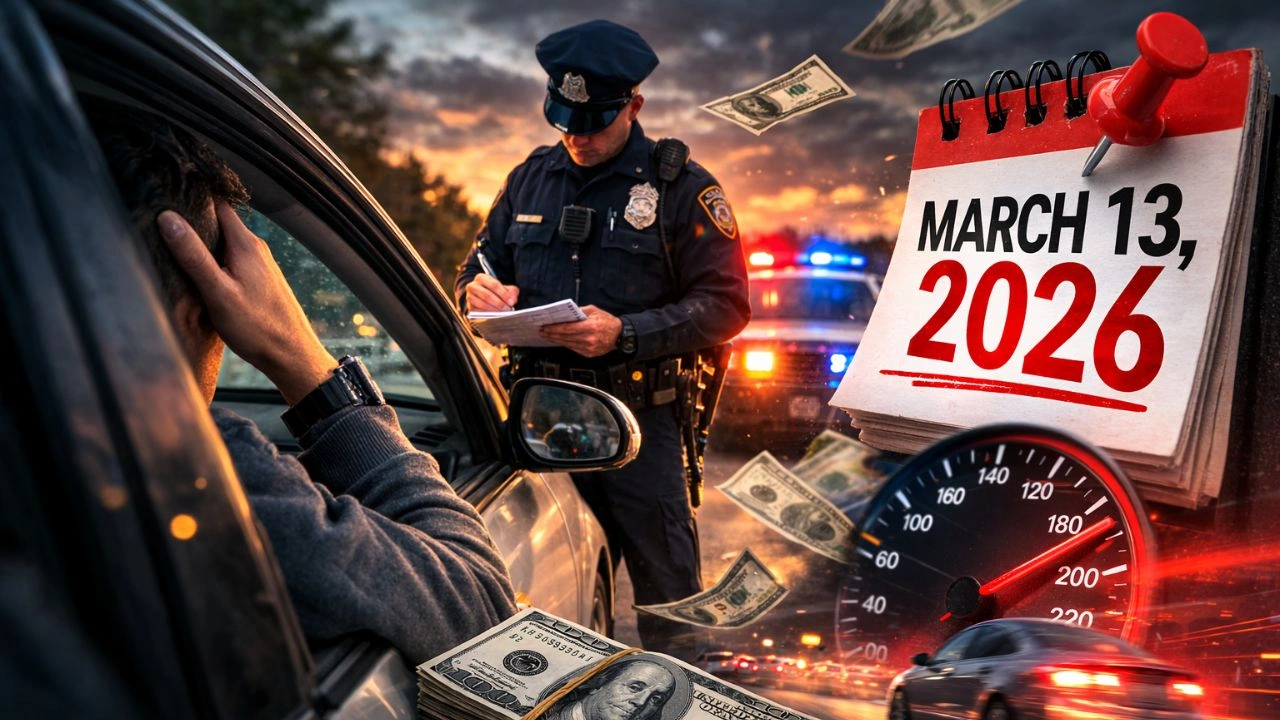
Traffic safety regulations continue to evolve as governments attempt to reduce road accidents and encourage responsible driving behavior. One of the most significant changes expected in 2026 involves a major increase in speeding penalties. Beginning March 13, 2026, drivers could face fines of up to $1,900 for certain speeding violations under updated traffic enforcement policies.
Why Traffic Authorities Are Increasing Speeding Fines
Rising road safety concerns
Speeding remains one of the leading causes of road accidents in many countries. Studies have consistently shown that higher speeds significantly increase both the likelihood of collisions and the severity of injuries.
Traffic authorities believe that stronger financial penalties can act as a powerful deterrent against reckless driving. When drivers know that speeding fines can reach as high as $1,900, they may be more likely to follow posted speed limits.
Encouraging responsible driving
The updated penalties are also designed to encourage safer driving habits. In many cases, drivers exceed speed limits because the consequences are relatively minor compared to the risks involved.
By increasing the cost of violations, policymakers aim to promote long-term behavioral change among drivers.
Supporting broader road safety strategies
The new speeding fine structure is often part of a broader strategy that includes improved enforcement, speed cameras, and educational campaigns.
These combined measures are intended to reduce traffic fatalities and create safer road environments for all road users.
Overview of the New Speeding Penalties
Maximum fine reaching $1,900
One of the most notable changes in the updated traffic regulations is the potential fine of up to $1,900 for certain high-speed violations.
The exact amount a driver may pay depends on several factors, including how far the driver exceeds the speed limit and whether the offense occurs in sensitive zones such as school areas or construction zones.
Graduated penalty system
Many jurisdictions use a tiered penalty structure that increases fines as the severity of the violation rises.
Drivers who exceed the speed limit by a small margin may face lower fines, while excessive speeding could trigger the maximum penalties.
Additional consequences beyond fines
In addition to financial penalties, speeding violations may also lead to other consequences such as:
demerit points on the driver’s license
temporary license suspension
increased insurance premiums
mandatory driving courses
These additional penalties reinforce the seriousness of traffic violations.
Example of Potential Speeding Fine Structure
| Speed Over Limit | Possible Fine |
|---|---|
| 1–15 mph over | Lower fine level |
| 16–25 mph over | Moderate penalty |
| 26–35 mph over | Higher fine |
| Extreme speeding | Up to $1,900 |
This table illustrates how fines may increase depending on the severity of the offense.
Impact on Drivers After March 13, 2026
Increased financial risk for violations
The most immediate impact of the new policy will be the higher financial burden for drivers who exceed speed limits.
A single speeding ticket could cost hundreds or even thousands of dollars depending on the circumstances.
Higher insurance premiums
Traffic violations often lead to increased insurance costs. Insurance providers consider speeding tickets as indicators of risky driving behavior.
As a result, drivers who receive citations may experience higher premiums for several years.
Potential license consequences
In some cases, repeated violations or excessive speeding may lead to license suspension.
Drivers who accumulate multiple demerit points could face additional penalties from licensing authorities.
Technology and Enforcement
Expanded use of speed cameras
Modern traffic enforcement relies increasingly on automated technologies.
Speed cameras and radar systems can detect violations with high accuracy and record evidence for enforcement.
Digital ticketing systems
Authorities are also adopting digital ticketing systems that streamline the process of issuing fines.
Drivers may receive electronic notifications of violations, making enforcement faster and more efficient.
Data-driven road safety strategies
Traffic authorities use data analysis to identify high-risk areas and implement targeted enforcement.
These strategies help reduce accidents in zones where speeding is most common.
Why Governments Are Taking a Tougher Approach
Preventing serious accidents
Speed is a major factor in many fatal road collisions. Even small increases in speed can significantly reduce reaction time and increase stopping distance.
Stricter penalties aim to address this problem by discouraging dangerous driving.
Protecting vulnerable road users
Pedestrians, cyclists, and motorcyclists are especially vulnerable to speeding vehicles.
By enforcing stricter traffic laws, authorities hope to create safer conditions for all road users.
Aligning with global road safety goals
Many governments are adopting stricter traffic enforcement policies as part of broader international road safety initiatives.
These initiatives focus on reducing traffic fatalities and promoting safer transportation systems.
Tips for Drivers to Avoid Speeding Penalties
Follow posted speed limits
The most effective way to avoid fines is simply to respect the posted speed limits.
Speed limits are established based on road design, traffic conditions, and safety considerations.
Stay aware of speed changes
Speed limits can change frequently depending on location. School zones, construction areas, and residential neighborhoods often have reduced limits.
Drivers should pay close attention to road signs.
Use modern driver assistance technology
Many modern vehicles include features that help drivers maintain safe speeds.
Examples include:
adaptive cruise control
speed limit recognition
driver alert systems
Using these technologies can help drivers avoid accidental violations.
Long-Term Effects of Higher Traffic Fines
Improved road safety
Higher penalties may contribute to a reduction in dangerous driving behaviors.
When drivers face significant financial consequences, they are more likely to comply with traffic regulations.
Behavioral changes among motorists
Over time, stricter enforcement can lead to a cultural shift in driving habits.
Drivers may become more cautious and attentive when operating their vehicles.
Safer urban environments
Cities with strict traffic enforcement often experience fewer serious accidents and improved pedestrian safety.
This contributes to better overall transportation systems.
Preparing for the New Rules
Staying informed
Drivers should stay updated on changes to traffic regulations in their area.
Understanding the new speeding penalties starting March 13, 2026 can help motorists avoid unexpected fines.
Reviewing driving habits
Adopting safer driving habits today can help drivers adapt to stricter enforcement policies.
Understanding local laws
Traffic regulations may vary depending on the jurisdiction. Drivers should familiarize themselves with local rules and enforcement practices.
Conclusion
The increase in speeding penalties to as much as $1,900 starting March 13, 2026 represents a significant shift in traffic enforcement policy. By introducing stricter fines and stronger deterrents, authorities aim to reduce dangerous driving behavior and improve road safety.
FAQ About the New Speeding Penalties Starting March 13, 2026
When will the new speeding fines of up to $1,900 take effect?
The updated traffic penalties are expected to begin on March 13, 2026, when stricter enforcement and higher fines for speeding violations will be implemented.
Will every speeding ticket cost $1,900?
No, the $1,900 fine represents the maximum penalty for serious speeding violations. Smaller infractions will typically result in lower fines depending on how much the driver exceeded the speed limit.
Can speeding tickets affect car insurance rates?
Yes, receiving a speeding ticket can lead to higher insurance premiums because insurers often view traffic violations as a sign of higher driving risk.